Richard Castro

How the Wii was hacked

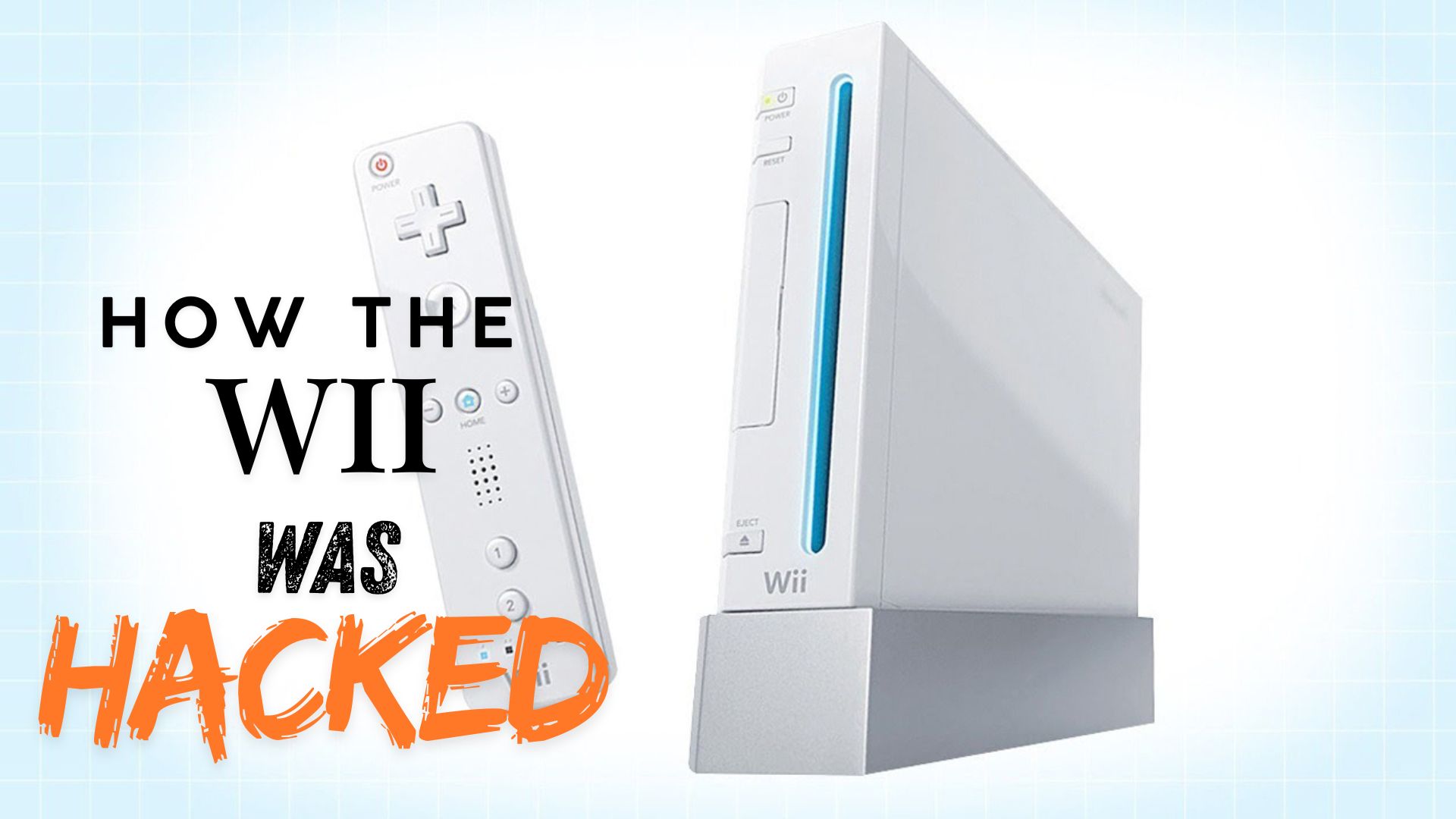
The Nintendo Wii hacking story is pure joy, chaos, and absolute creative genius. While Sony was fighting multi-million dollar corporate warfare, Nintendo was dealing with a community that hacked their console using a cheap tweezers, a retail copy of The Legend of Zelda, and an intentional laser alignment bug.
The Wii story is legendary because hackers didn’t just break the system—they essentially built a parallel operating system (The Homebrew Channel) that was so elegant and stable it put Nintendo’s own software to shame.
Here is the blueprint for your Wii teaser story.
 
The GameCube Trojan Horse
Nintendo made a massive strategic bet with the Wii: instead of building an expensive, high-tech powerhouse like the PS3, they essentially took the hardware architecture of their previous console, the GameCube, overclocked it, and added motion controls.
  • The Vulnerability: Because the Wii was physically a “supercharged GameCube” under the hood, it inherited all of the GameCube’s older, well-documented security flaws.
  • The Bridge: Early hackers quickly realized they could trick the Wii into running old GameCube exploit discs. This gave them an immediate foothold into the Wii’s memory before anyone had even looked at the new Wii software.
 
The “Twilight Hack” (The Save File Inception)
The first massive breakthrough that blew the console wide open didn’t require opening the hardware at all. A legendary hacker named Team Twiizers (named after a literal pair of tweezers they used in early hardware probing) targeted The Legend of Zelda: Twilight Princess.
  • The Exploit: They discovered a classic “buffer overflow” vulnerability in how the game loaded the main character’s name from a save file.
  • The Trigger: Hackers created a hacked save file where Link’s horse, Epona, had a name that was thousands of characters longer than the game expected.
  • The Collapse: When a player loaded the save and walked backward to talk to a specific character, the game tried to load the massive name, panicked, crashed, and accidentally executed a hidden payload of homebrew code hidden inside the save file.
Suddenly, anyone with an SD card and a copy of Zelda could jailbreak their console.
 
The Homebrew Channel: The Parallel Universe
Once inside, the community didn’t just pirate games; they built an entire ecosystem. They created The Homebrew Channel, a custom channel that sat right on the official Wii menu. It looked and felt like an official Nintendo app, complete with smooth animations and custom music. Through this channel, users could load emulators, media players, and custom themes, completely transforming the Wii into a multimedia powerhouse.
 
The Blue Wire and the Ultimate Defeat (LetterBomb)
Nintendo desperately tried to patch the Zelda exploit with system updates, sparking a brilliant cat-and-mouse game. Every time Nintendo locked a door, hackers found a window.
  • The “Tweezer” Attack: To bypass later hardware security revisions, hackers discovered that if you literally took a pair of tweezers and short-circuited a specific data line on the Wii’s motherboard at a precise millisecond during bootup, it forced the console’s security chip to report “all clear.”
  • LetterBomb: The final, absolute death blow to the Wii’s security arrived via the Wii Message Board. Hackers realized they could send a corrupted text notification—shaped like a literal red letter with a bomb icon—directly to the Wii’s internal calendar. Clicking the letter executed code and broke the console completely, requiring no games or hardware modifications at all.
How the PS3 was hacked

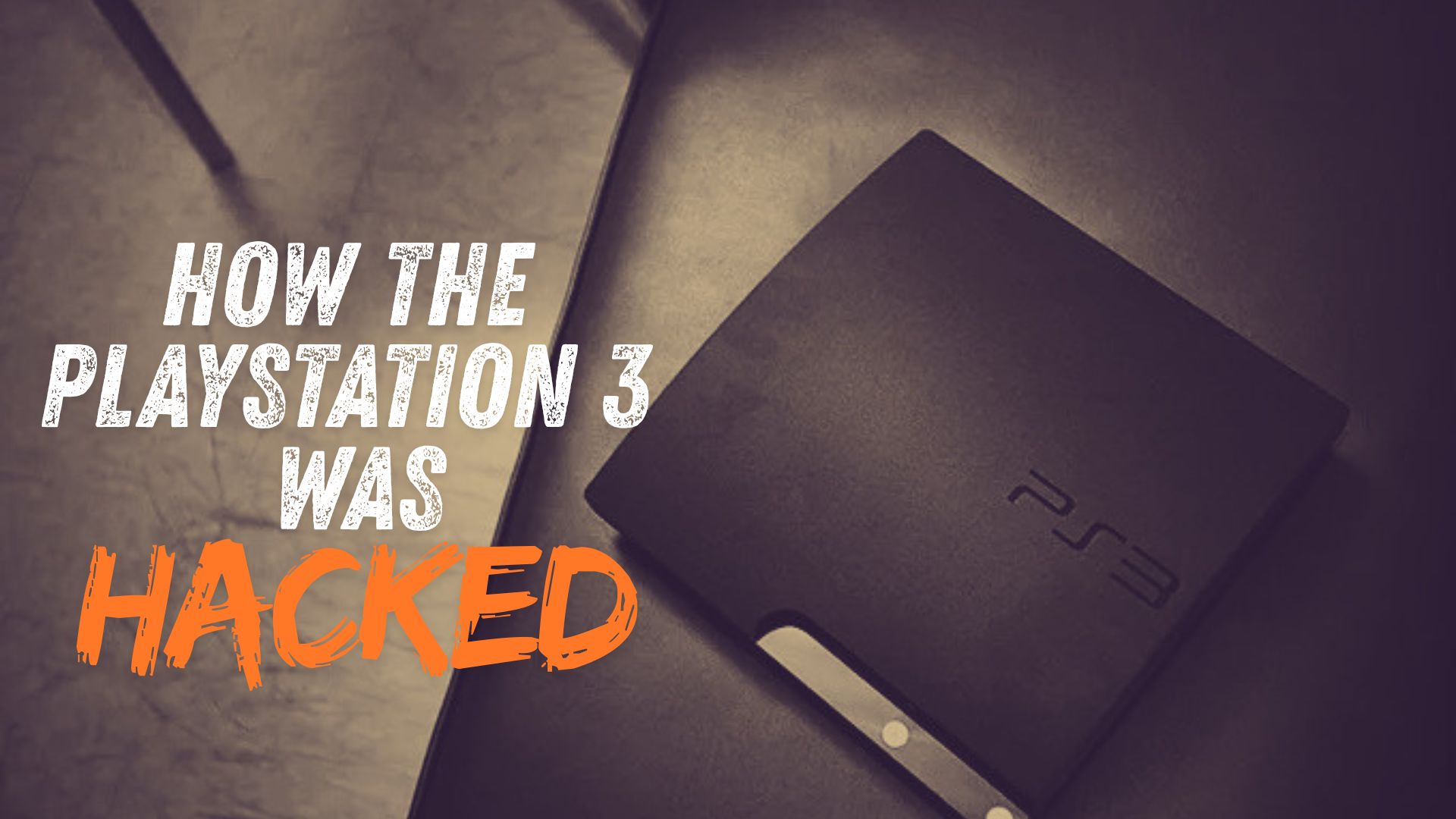
The PS3 hack is arguably one of the most legendary, high-stakes dramas in cybersecurity history. While the PS2 hack was about clever mechanical tricks and gray-market factories, the PS3 hack was pure, high-level cryptography, a massive mathematical blunder, a public war with Sony, and a historic hacktivist retaliation.
Here is the wild story of how the “unhackable” console was completely brought down.
 
The “Unhackable” Fort Knox (2006–2009)
When Sony launched the PS3, they were determined to prevent another PS2-era piracy boom. They built the console around a cutting-edge, highly complex Cell Broadband Engine processor and a hypervisor security layer.
  • The “OtherOS” Peace Treaty: Sony did something unprecedented. To appease hackers and researchers, they legally allowed users to install Linux on the PS3 via a feature called “OtherOS.”
  • The Catch: Linux was locked inside a “sandbox.” It gave hackers access to the processor but completely blocked them from touching the graphics card, the hypervisor, or the game encryption keys. Because hackers had a legal playground, nobody felt the need to break the console’s actual security for nearly four years.
 
Enter GeoHot and the Stolen Peace (2010)
In late 2009, a 20-year-old hacker named George Hotz (GeoHot)—famous for being the first person to jailbreak the iPhone—turned his attention to the PS3.
  • The Hardware Glitch: GeoHot used a primitive but brilliant hardware attack. He physically soldered a switch to the PS3 motherboard and flipped it to short-circuit the memory bus for a microsecond right when the console booted.
  • The Breach: This split-second electrical glitch confused the hypervisor, causing it to accidentally grant GeoHot full access to the system memory.
  • Sony’s Fatal Mistake: Panicked by GeoHot’s breakthrough, Sony released firmware update 3.21, which entirely removed the “OtherOS” Linux feature from every PS3 worldwide.
Sony’s nuclear option completely backfired. By taking away the legal playground, they infuriated the entire global hacking community. Suddenly, breaking the PS3 wasn’t just a hobby—it was personal revenge.
 
The fail0verflow Blunder: God-Level Math Mistakes
With the community now motivated by spite, a fail0verflow research group stepped up at the Chaos Communication Congress in December 2010. They didn’t just find a workaround; they found a catastrophic cryptographic mistake made by Sony’s programmers.
The PS3 secured its software using ECDSA (Elliptic Curve Digital Signature Algorithm). This math requires a public key, a private key, and a randomly generated number (called a nonce, or “k”) for every single signature to prevent anyone from calculating the master private key.
Sony’s programmers made the ultimate rookie cryptographic error: they set the random number k to a constant [2]. It was hardcoded. It never changed.
 
// Visualizing Sony's security logic:
Actual Cryptography:  k = random_number()
Sony's Code:          k = 4; // Chosen by fair dice roll. Guaranteed to be random.
Because the “random” number was identical across every single game and update, fail0verflow used basic high school algebra to isolate the equation and extract Sony’s Master Private Root Key.
 
Absolute Defeat and Custom Firmware
GeoHot took fail0verflow’s findings, calculated the final root key, and published it on his blog.
This was the holy grail. With the master key, hackers could sign any software, game, or operating system, and the PS3 would blindly accept it as an official, factory-authorized update straight from Sony. Sony couldn’t even patch it out with a software update because the keys were hardcoded into the silicon of the console’s processor. The PS3 security model was completely dead.
 
The Fallout: Lawsuits and Anonymous
Sony went to war. They filed a massive federal lawsuit against GeoHot, convincing a judge to let them seize his hard drives and track the IP addresses of anyone who visited his website.
This heavy-handed corporate retaliation triggered Anonymous, the infamous hacktivist collective.
  • In April 2011, Anonymous launched “Operation Sony,” hitting Sony’s servers with relentless Distributed Denial of Service (DDoS) attacks.
  • Amidst the chaos, the PlayStation Network (PSN) was completely breached, exposing the personal data of 77 million users.
  • Sony was forced to shut down the entire PlayStation Network for a staggering 23 days, costing the company over $170 million in damages.
GeoHot eventually settled out of court with Sony, agreeing never to hack another Sony product again, but the damage was irreversible. The “Unhackable” console had been laid bare all because a programmer didn’t want to generate a random number.

Chaos Computer Club (CCC)

Origins of CCC

Chaos Computer Club (CCC) is Europe’s largest hacker association and a major global voice in cybersecurity, privacy, and digital rights. Founded in West Berlin in 1981 by Wau Holland, the CCC advocates for information freedom, transparency, and a strict ethical code known as the Hacker Ethics.

Key Milestones & Exploits

  • BTX Hack (1984): Exploited a flaw in the German postal teletext system to siphon 134,000 DM from a bank. They returned the money the next day to expose system vulnerabilities.
  • KGB Hack (1986): Group members compromised U.S. government and corporate mainframes, selling the stolen source code to the Soviet KGB.
  • Touch ID Bypass (2013): Spoofed Apple’s iPhone fingerprint sensor using a high-resolution photograph of a print on a glass surface.

Core Philosophies

  • Public Information: All public data should be completely free and accessible to everyone.
  • Private Data: Individual personal data must be aggressively protected from government and corporate surveillance.
  • Constructive Hacking: Technology should be broken down to understand it, improve it, and protect the public.

Major Events

  • Chaos Communication Congress: An annual four-day conference held in December, serving as one of the world’s premier hacker gatherings.
  • Chaos Communication Camp: A massive outdoor hacker festival and camping event held once every four years in Germany.

Masters of Deception

Origins of MOD

The Masters of Deception (MOD) was an elite, New York-based hacker group in the early 1990s. Famous for the “Great Hacker War” against the rival Legion of Doom (LoD), they dominated early telephone networks and shaped the foundation of modern cybersecurity and hacker culture.

Who Were the Masters of Deception?

Unlike early hackers who often came from privileged backgrounds, MOD was a diverse, blue-collar crew. They operated out of New York City using inexpensive computers to master the intricacies of telecommunications.
  • Key Members included:
    • Phiber Optik (Mark Abene)
    • Acid Phreak (Elias Ladopoulos)
    • Scorpion (Paul Stira)
    • Corrupt (John Lee)
    • Outlaw (Julio Fernandez)
i

The Great Hacker War

In the late 1980s and early 1990s, MOD engaged in a legendary cyber feud with the Texas-based Legion of Doom (LoD). The conflict—often characterized as the climax of the internet’s “Golden Age”—involved downloading confidential credit histories, tapping phone lines, and locking each other out of corporate networks.

The Bust & Legacy

The FBI’s Secret Service stepped in, using an unprecedented authorized datatap to monitor the hackers’ activities. In 1992, key members of MOD were indicted, pleaded guilty, and served federal prison sentences.
Despite their early arrests, many MOD alumni transitioned into successful, white-hat cybersecurity careers. Their exploits have been chronicled in books like Masters of Deception on Amazon and explored in tech podcasts such as Darknet Diaries.

Legion of Doom

Origins of LOD

Formed in 1984 by a hacker named Lex Luthor, the Legion of Doom (LOD) was <mark>one of the most influential and skilled hacking collectives in digital history</mark>. Operating primarily through early Electronic Bulletin Board Systems (BBS), LOD wasn’t focused on stealing money; they were digital explorers fascinated by the inner workings of the emerging global network. 

Disrupting the Telecom Giants

 LOD’s primary playground was the phone system. They mastered phreaking—manipulating telephone networks to make free long-distance calls and reroute lines. 

As they evolved, they hacked into the backends of major telecommunications giants like AT&T and MCI. They mapped out switching networks, intercepted internal data, and gained unprecedented control over the infrastructure that connected the United States. 

The Hacker War and the E911 Document

LOD’s notoriety peaked during a legendary, toxic rivalry with a splinter group called the Masters of Deception (MOD). This “Hacker War” resulted in both groups actively trying to crash each other’s servers and phone lines, causing massive digital collateral damage. 

The final straw for the U.S. government came when an LOD member copied an internal AT&T administrative document regarding the E911 emergency phone system. Although the document contained relatively basic operational text rather than code to dismantle 911, its theft sent the federal government into a panic. They feared a rogue group of teenagers could cripple America’s emergency response infrastructure.

The Hoax of the “Trillion-Dollar” Threat

The government used the E911 document to paint LOD as a catastrophic national threat, leading directly to Operation Sundown in 1990—a massive Secret Service crackdown on hackers. The media parroted claims that LOD threatened the entire country, which was a wild exaggeration.

The resulting legal battles exposed how little prosecutors actually understood about technology. When the government attempted to prosecute hackers for the E911 document, the defense proved the “secret” information was actually available to the public in a manual anyone could order for $13. The case fell apart, but the panic fueled the creation of the Electronic Frontier Foundation (EFF) to protect digital civil liberties. 

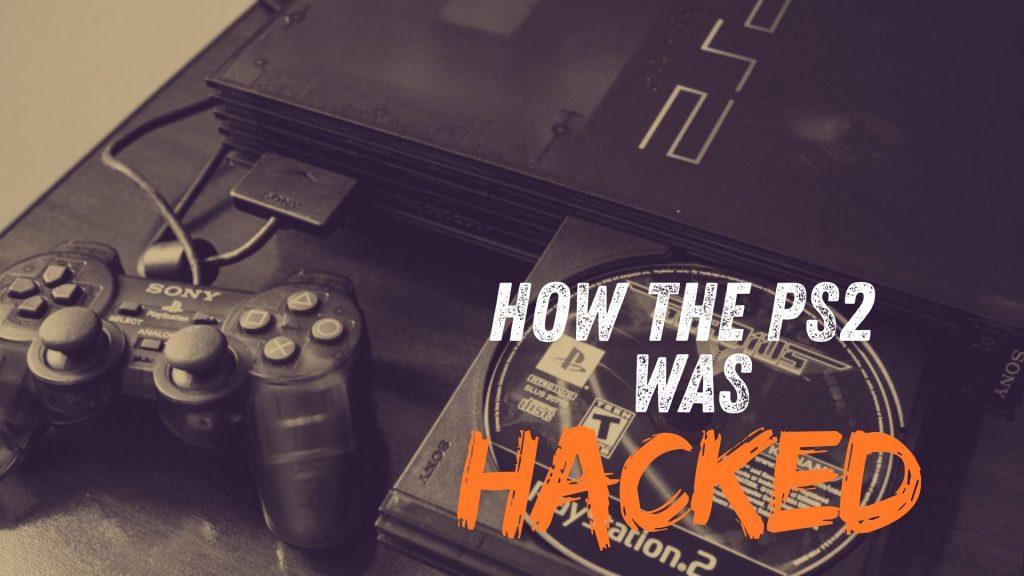
How the PS2 was hacked

The Madden Surgery: The Dawn of PS2 Modding

Before mass-production took over, early hackers realized the PS2 only checked for authenticity on the innermost ring of the disc.
  • The Target: Hackers bought stacks of dirt-cheap, heavily discounted licensed games (usually old sports titles like Madden or FIFA).
  • The Operation: Using precise industrial cutting tools, they sliced out the tiny center ring containing the genuine Sony authentication signature.
  • The Monster: They physically glued or fused this genuine center ring onto a burned, unauthorized copy disc.
  • The Result: The PS2 laser read the genuine inner ring, declared it “authorized,” and happily booted the pirated game data on the rest of the disc.

Going Industrial: Sourcing the Gray Market

Frankenstein discs weren’t profitable at scale. To make commercial products like Swap Magic, hackers had to stop cutting up discs and start making their own.
  • The Secret Blueprint: Hackers reverse-engineered the PS2 laser’s “wobble groove”—a physical imperfection in the plastic that acted as a hardware key.
  • The Glass Masters: They used this data to create custom glass master molds, embedding the fake Sony “handshake” into the physical layout.
  • The Underworld Factories: Instead of stealing Sony’s machines, they took these molds to independent, gray-market CD/DVD factories in Asia and Eastern Europe that were willing to ignore copyright laws for a massive payday.

The Mechanical Trick: Swap Magic

Once these factory-pressed “Trojan Horse” discs were sold to consumers, the software trick could begin.
  • The Fake Out: The user boots the factory-pressed Swap Magic disc. The PS2 reads the cloned physical structure and thinks it is an official game.
  • The Heist: The software stops the disc spin but keeps the console’s motherboard in an “authorized” state.
  • The Slide Tool: Instead of pressing the electronic eject button (which would alert the console), users used a plastic hook to physically force the tray open, swap the disc for a cheap burned DVD-R, and slide it shut.
  • The Play: The PS2, completely blind to the physical swap, resumed reading data from a totally unauthorized disc.

The Black Market

the creators of Swap Magic completely reverse-engineered the PS2’s security data and hired massive, independent industrial disc-pressing factories—often located in Asia or Eastern Europe—that operated completely outside of Sony’s legal control.
A consumer CD/DVD burner works by using a laser to burn temporary chemical “dyes” onto a disc. This cannot replicate the physical, molded grooves of an official PlayStation 2 disc. To mass-produce boot discs that the PS2 would recognize as authentic, hackers used a sophisticated industrial pipeline:

Reverse Engineering the “Wobble Groove”

Every genuine PS2 disc features a physical, intentional imperfection molded directly into the plastic tracking ridge, often referred to as a wobble groove. As the PS2’s laser reads the disc, it measures how much the beam physically wobbles. This wobble functions as a hardware-level cryptographic key.
Through meticulous trial and error using specialized equipment, hackers successfully mapped out the exact geometric layout, physical pit depths, and data sectors (specifically sectors 0 through 99) that contained this critical authentication handshake.

Sourcing Gray-Market Optical Disc Factories

Industrial disc-pressing factories were quite common in the late 1990s and early 2000s due to the global music CD and movie DVD boom. While Sony owned its proprietary plants, hundreds of independent factories worldwide pressed media for independent artists and movie companies.
  • Swap Magic’s creators generated a glass master mold using their reverse-engineered layout. This glass mold contained the physical microscopic bumps and the required security “wobble.”
  • They took this custom glass master to a gray-market factory willing to overlook copyright licensing.
  • The factory’s injection molding machinery pressed molten polycarbonate plastic into the mold, physically stamping the PS2 authentication markings directly into the plastic structure of the discs.

The Bulk “Transplant” Myth and Reality

Rumors persisted for years that hackers stole stamping machines or used “donor discs,” which muddied the history. While massive operations like Swap Magic relied entirely on gray-market factory printing, smaller, boutique hacker groups did occasionally use a manual fallback method called transplanting:
  • They would purchase massive quantities of the cheapest, legally licensed PS2 games available (such as budget sports titles).
  • Using precise industrial cutting tools, they would physically slice out the center ring of the real, licensed game, which contained the authentic Sony signature.
  • They then physically glued or fused this genuine center ring onto an unauthorized copy disc.
This transplant method was far too slow for commercial operations like Swap Magic, but it confirmed to the community that the console only cared about the physical geography of the inner disc ring during the initial boot phase.
For your blog, framing it around the “Industrial Gray-Market Loophole” captures the reality. They didn’t steal Sony’s hardware; they simply brought Sony’s closely guarded data blueprints to independent manufacturing plants that Sony didn’t have the jurisdiction to shut down

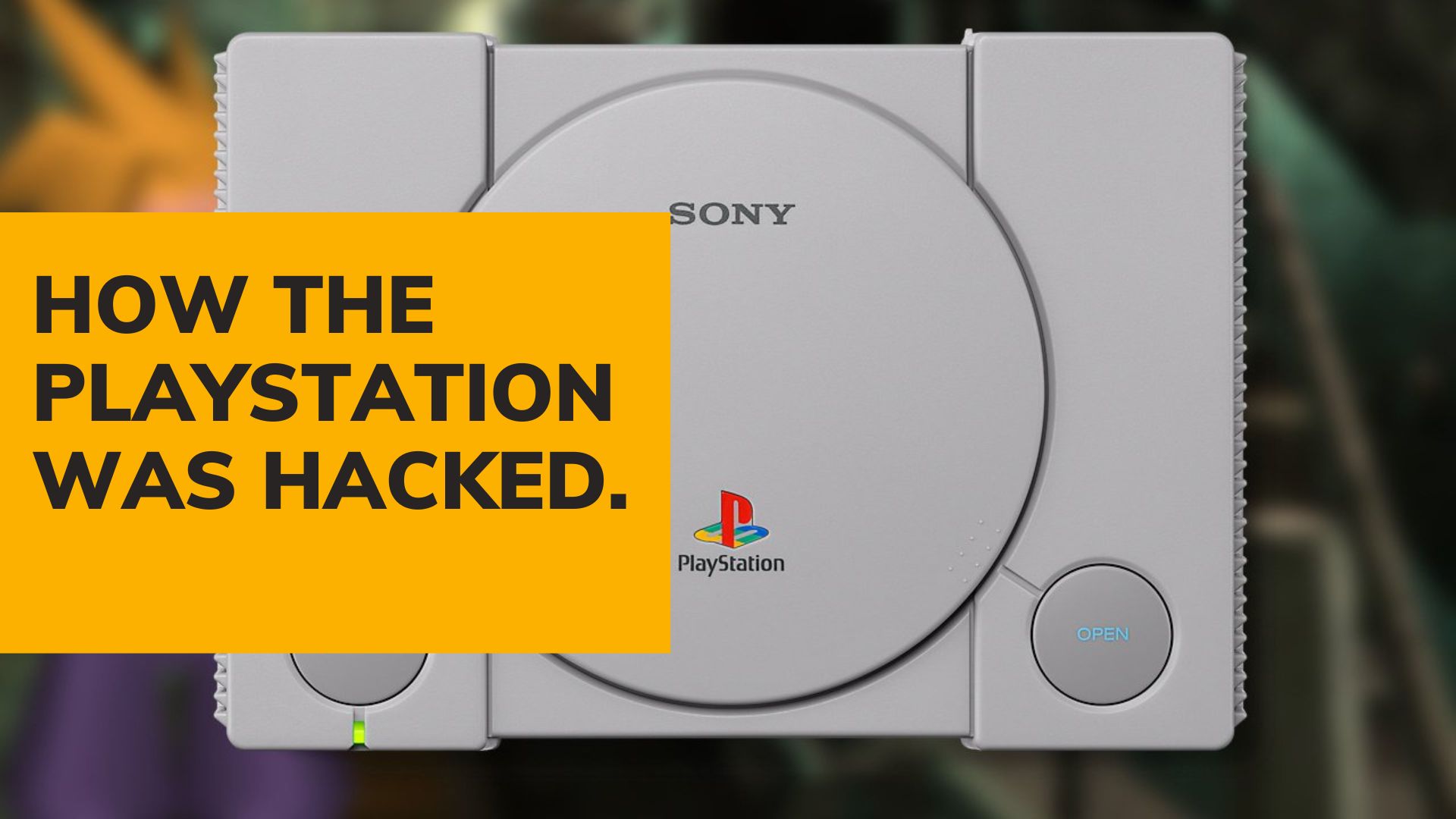
How the PS1 was hacked

The Purpose

Sony was concerned about using cd rom games because CD burners were already widely available, and they were worried about pirated games. Sony decided to accomplish this through hardware instead of software. 


Sony did not use software encryption to protect PS1 games. Instead, they used a physical manufacturing trick:

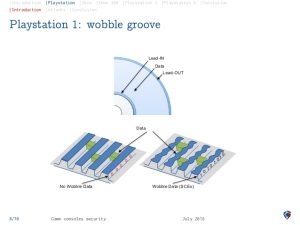
  • The Wobble: Official PS1 discs had a microscopic, wavy deviation in the data track called a “wobble groove”.
  • The Country Code: This wobble vibrated at a specific frequency that spelled out an ASCII string (“SCEA” for America, “SCEE” for Europe, “SCEI” for Japan).
  • The Laser: The PS1 hardware laser read this physical wobble only during the first few seconds of booting a disc.
  • The Catch: Standard consumer CD burners could not replicate this physical wobble groove on blank CD-Rs. If the PS1 laser didn’t detect the wobble, it assumed the disc was a pirate copy and blocked it.

The Wobble

Sony added a factory-burned ‘wobble ring’ that no consumer CD burner could duplicate. This wobble ring was read on boot up. Once the ring was read and comfirmed bu the cpu, the sony did a soft-reboot and started the game. 
The Swap Trick

The exact method Sony used allowed for an insanely simple way to bypass the security. The Swap Trick. 
 

The earliest hack required zero hardware modifications, relying purely on timing and physics:

  • The Jam: Hackers used a piece of tape or a plastic clip to hold down the console’s lid-sensor switch, fooling the PS1 into thinking the door was always closed.
  • The Switcheroo: A user would insert a legitimate, licensed PS1 game.
  • The Bypass: The console would spin the real disc, successfully read the physical wobble groove, and pass the security check.
  • The Swap: The second the security check passed—but right before the console began reading the actual game data—the user quickly swapped out the real disc for a burned CD-R while the motor was still spinning. The console, thinking it was still playing the authenticated disc, would run the pirated game.


The Mod

Later on, mod chips were created that automated this method. 
 

Because the swap trick was tedious and could damage the console’s spindle motor, hackers engineered the modchip. This kickstarted the golden age of console modding.

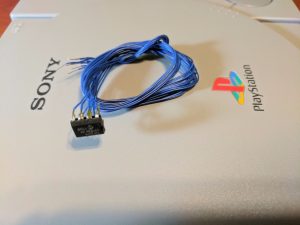
  • The Injection: A small microcontroller (like the PIC12C508) was soldered directly to the PS1’s optical drive controller board.
  • The Lie: When the console booted up, the modchip intercepted the security check and electronically fed the “SCEA/E/I” frequency string directly into the console’s controller chip.
  • The Result: The modchip completely blinded the console to what was actually in the disc tray. The PS1 would happily boot any burned CD-R or foreign region game instantly, without needing a manual swap.

Sorting Algorithms

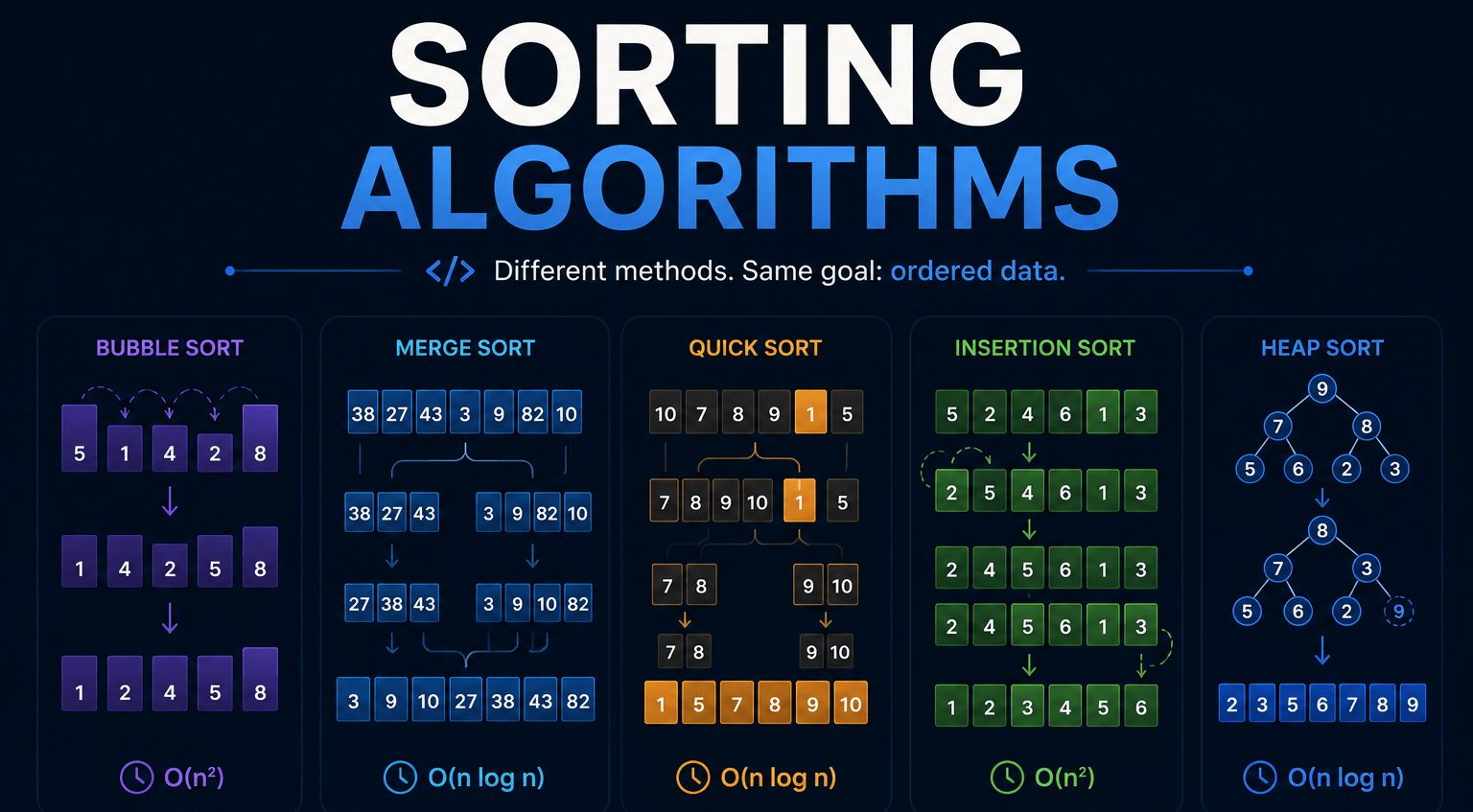
Sorting algorithms are the hidden engines behind how we organize data, from ranking your search results to filtering your online shopping carts. While they all achieve the exact same goal, how they get there under the hood varies wildly in speed, memory use, and pure cleverness. Whether you are prepping for a tech interview or just curious about how computers think, here is a quick look at four foundational sorting algorithms you should know.

Bubble Sort

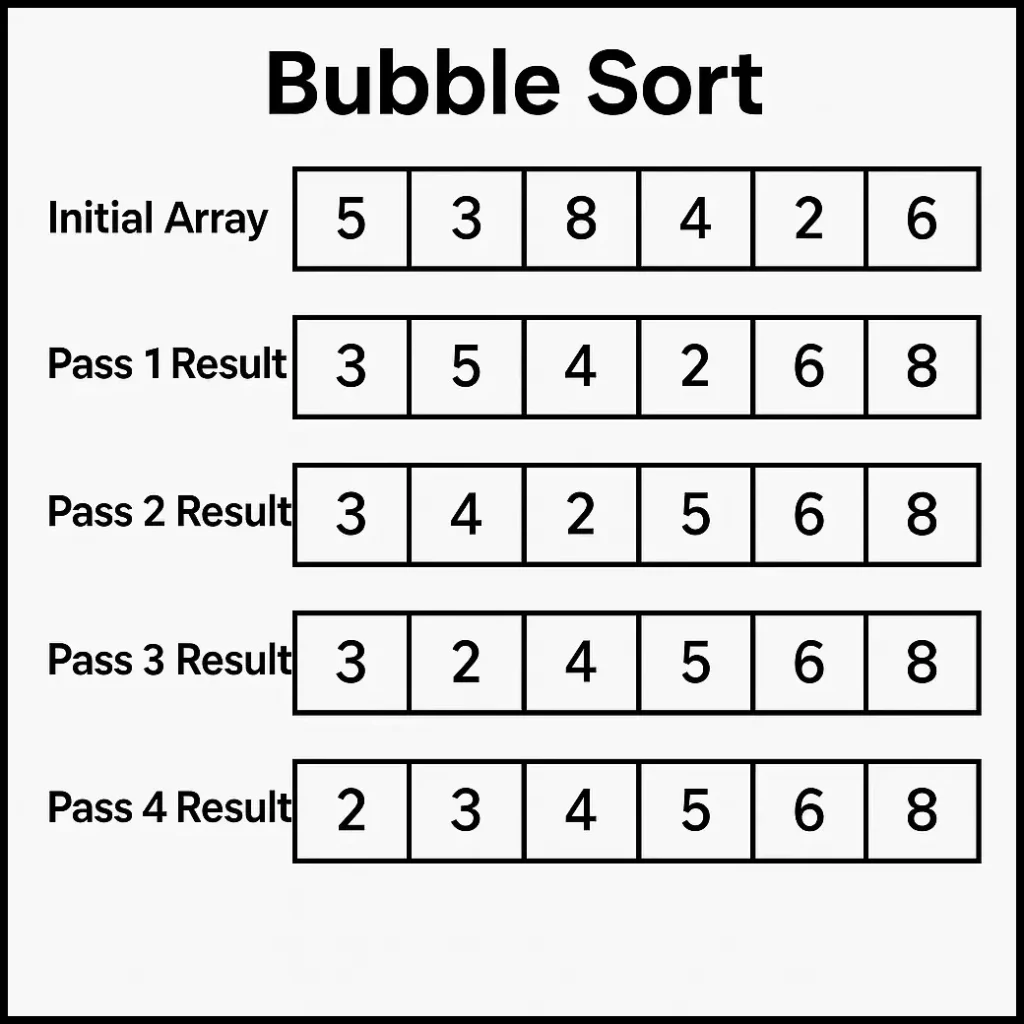
Bubble sort is the absolute classic “hello world” of computer science. It works exactly how it sounds: it repeatedly steps through your data, compares adjacent items, and swaps them if they are in the wrong order. The largest (or smallest) numbers gradually “bubble” up to their correct positions at the end of the list with each pass. While incredibly intuitive to grasp, it is terribly slow for large datasets because of its \(\mathcal{O}(n^2)\) time complexity.

Insertion Sort

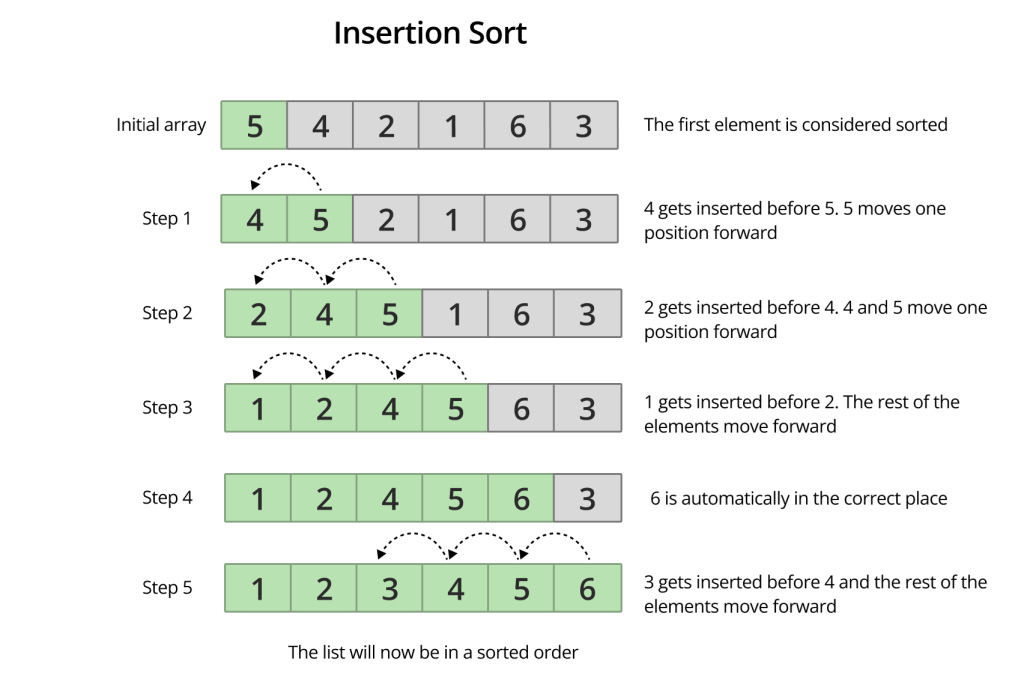
iInsertion Sort is the algorithm you likely use subconsciously every time you organize a hand of playing cards. It splits your data into a “sorted” and “unsorted” section, pulling one item at a time from the unsorted pile and shifting it into the correct spot within the sorted section. It performs very well on partially sorted data and uses hardly any extra memory, making it a highly practical and efficient approach for smaller datasets.

Quick Sort

Quick Sort is a highly efficient, “divide-and-conquer” approach to handling massive amounts of data. It works by picking a “pivot” element and then partitioning the rest of the array so that all numbers smaller than the pivot go to the left, and all larger numbers go to the right. It then recursively applies this same process to the left and right sub-arrays. Because it shaves off large chunks of work in every step, it averages an impressive \(\mathcal{O}(n \log n)\) time complexity.

Heap Sort

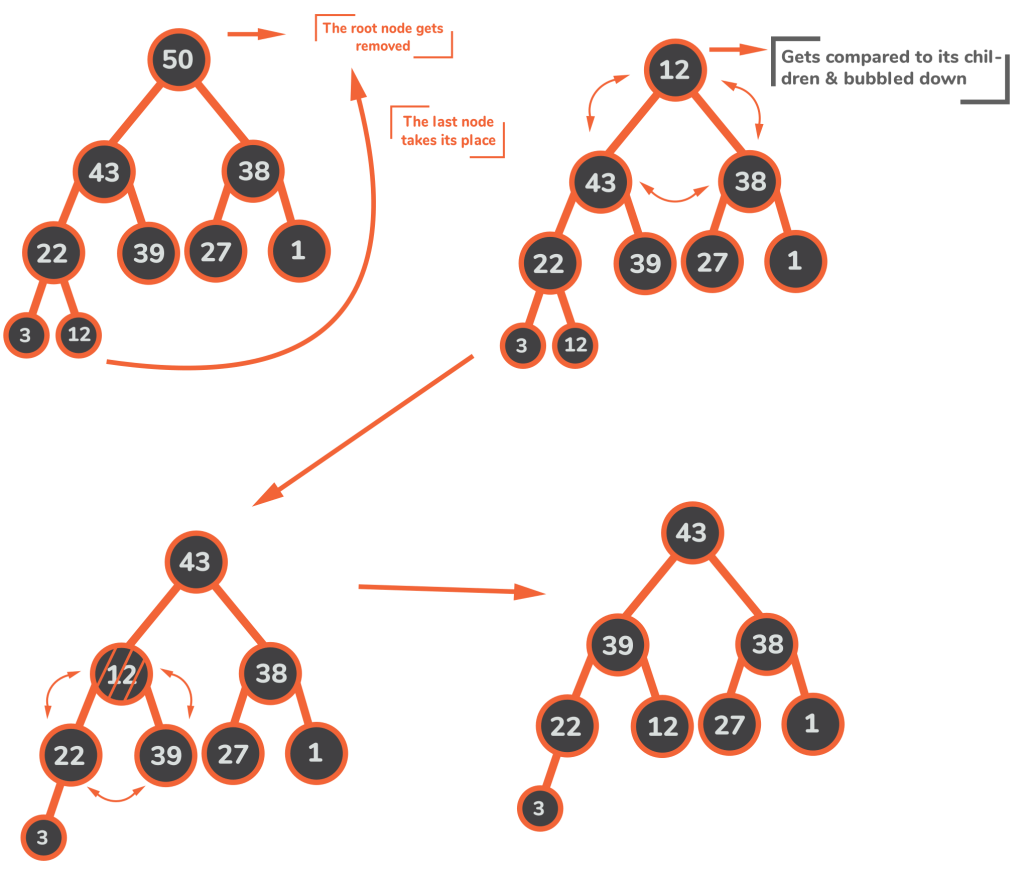
Heap Sort takes a completely different route by first organizing all your data into a tree-based structure called a binary heap. Once the data is structured, the largest (or smallest) item sits right at the top. The algorithm extracts this top item, places it in its final sorted position, and then restructures the tree to find the next item. The result is a highly reliable algorithm with a \(\mathcal{O}(n \log n)\) time complexity, guaranteeing great performance even in the absolute worst-case scenarios.

The First Programmable Computer

What is a computer?

Today, the word computer usually refers to an electronic device capable of processing information and running software. However, the term originally described a person whose job was to perform mathematical calculations by hand. During the nineteenth and early twentieth centuries, inventors began creating mechanical calculating machines to automate these tasks. Charles Babbage’s designs for the Difference Engine and Analytical Engine introduced concepts that resemble modern computing, but they were never fully realized. As technology advanced through electromechanical and electronic systems, the definition of a computer shifted from a human occupation to a machine capable of following instructions. The next major step was the development of the programmable computer—a machine that could be reconfigured to perform different calculations without being physically rebuilt.

Konrad Zuse and the road to the Z3

One of the pioneers of programmable computing was German engineer Konrad Zuse. In the 1930s, while working as a civil engineer, Zuse became frustrated with the repetitive calculations required for engineering projects. He believed that machines should perform these tedious mathematical tasks. Working largely on his own and with limited financial support, he began building a series of experimental computers in his parents’ apartment in Berlin. His early machines, the Z1 and Z2, explored the use of binary arithmetic and automated computation. These projects eventually led to the creation of the Z3, which would become his most significant achievement.

The Z3

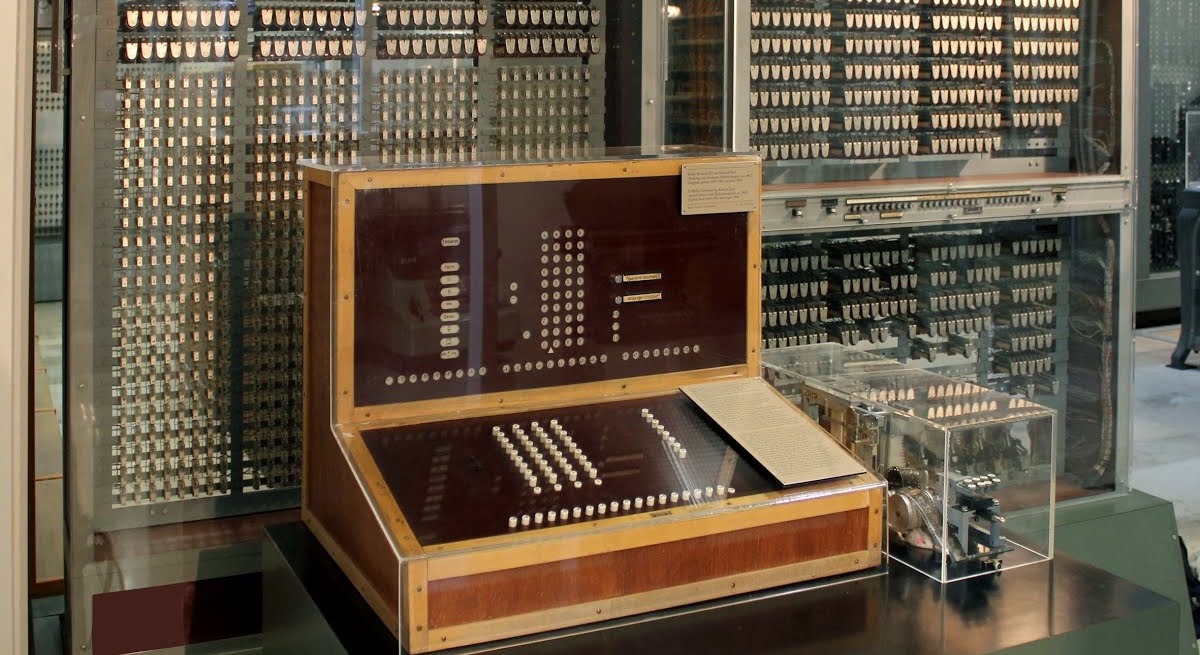
Completed in 1941, the Z3 is widely regarded as the world’s first fully operational programmable, automatic digital computer. It used approximately 2,600 electromechanical relays and operated using binary arithmetic rather than the decimal systems common in calculators of the era. Programs and data were entered through punched film, allowing the machine to be programmed for different tasks. Although its clock speed was measured in just a few hertz and calculations could take several seconds, the Z3 was capable of performing complex engineering and scientific computations automatically. In many ways, it demonstrated the fundamental principles that define modern computers: programmability, automation, and digital processing.

Legacy

The Z3’s impact was not widely recognized at the time. Much of Zuse’s work occurred during World War II, and the original machine was destroyed in an Allied bombing raid in 1943. Nevertheless, historians now consider the Z3 a major milestone in computing history. It proved that a programmable digital computer was not only possible but practical, laying groundwork for later developments in electronic computing. While modern computers are millions of times faster and more powerful, they still rely on the same core idea that drove Konrad Zuse’s invention: a machine that can follow stored instructions to solve a wide variety of problems.