
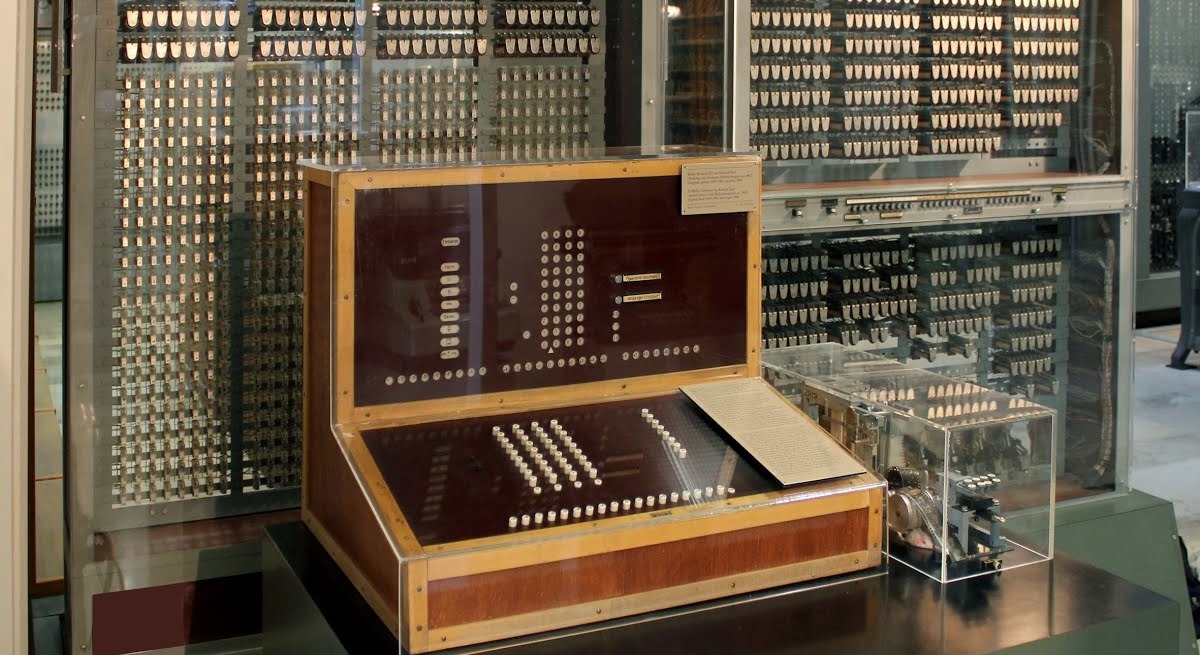
The First Programmable Computer
What is a computer?
Today, the word computer usually refers to an electronic device capable of processing information and running software. However, the term originally described a person whose job was to perform mathematical calculations by hand. During the nineteenth and early twentieth centuries, inventors began creating mechanical calculating machines to automate these tasks. Charles Babbage’s designs for the Difference Engine and Analytical Engine introduced concepts that resemble modern computing, but they were never fully realized. As technology advanced through electromechanical and electronic systems, the definition of a computer shifted from a human occupation to a machine capable of following instructions. The next major step was the development of the programmable computer—a machine that could be reconfigured to perform different calculations without being physically rebuilt.
Konrad Zuse and the road to the Z3
One of the pioneers of programmable computing was German engineer Konrad Zuse. In the 1930s, while working as a civil engineer, Zuse became frustrated with the repetitive calculations required for engineering projects. He believed that machines should perform these tedious mathematical tasks. Working largely on his own and with limited financial support, he began building a series of experimental computers in his parents’ apartment in Berlin. His early machines, the Z1 and Z2, explored the use of binary arithmetic and automated computation. These projects eventually led to the creation of the Z3, which would become his most significant achievement.
The Z3
Completed in 1941, the Z3 is widely regarded as the world’s first fully operational programmable, automatic digital computer. It used approximately 2,600 electromechanical relays and operated using binary arithmetic rather than the decimal systems common in calculators of the era. Programs and data were entered through punched film, allowing the machine to be programmed for different tasks. Although its clock speed was measured in just a few hertz and calculations could take several seconds, the Z3 was capable of performing complex engineering and scientific computations automatically. In many ways, it demonstrated the fundamental principles that define modern computers: programmability, automation, and digital processing.
Legacy
The Z3’s impact was not widely recognized at the time. Much of Zuse’s work occurred during World War II, and the original machine was destroyed in an Allied bombing raid in 1943. Nevertheless, historians now consider the Z3 a major milestone in computing history. It proved that a programmable digital computer was not only possible but practical, laying groundwork for later developments in electronic computing. While modern computers are millions of times faster and more powerful, they still rely on the same core idea that drove Konrad Zuse’s invention: a machine that can follow stored instructions to solve a wide variety of problems.