
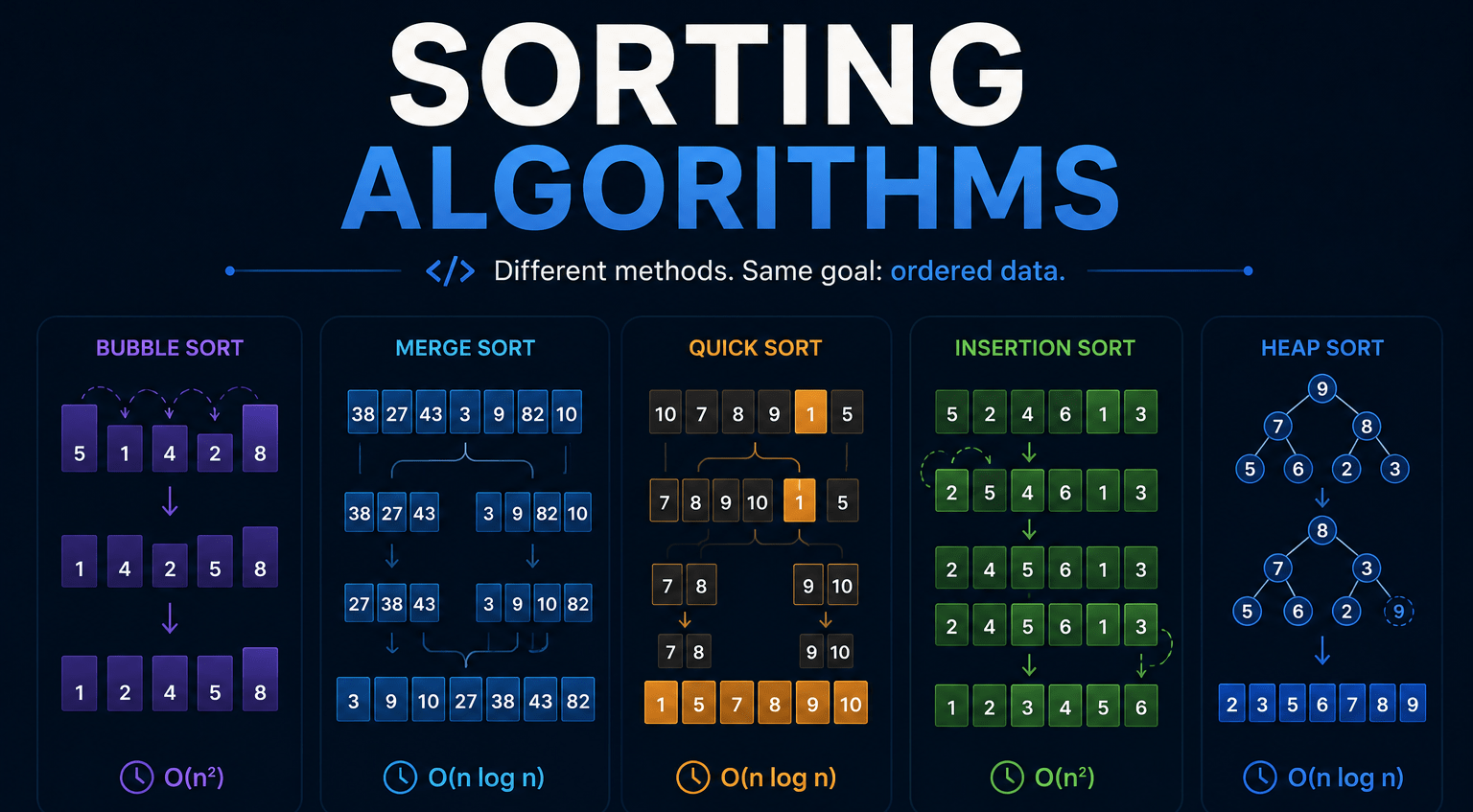
Sorting Algorithms

Sorting algorithms are the hidden engines behind how we organize data, from ranking your search results to filtering your online shopping carts. While they all achieve the exact same goal, how they get there under the hood varies wildly in speed, memory use, and pure cleverness. Whether you are prepping for a tech interview or just curious about how computers think, here is a quick look at four foundational sorting algorithms you should know.
Bubble Sort
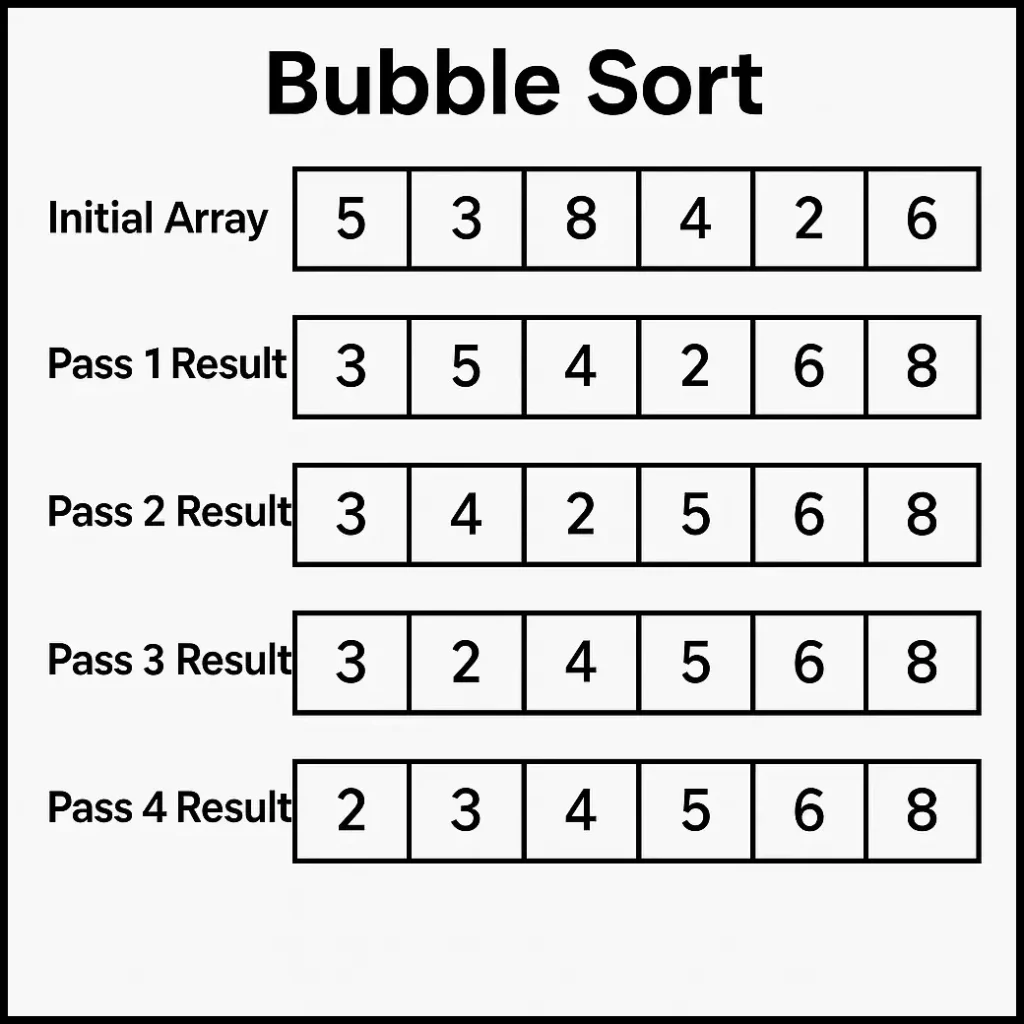
Bubble sort is the absolute classic “hello world” of computer science. It works exactly how it sounds: it repeatedly steps through your data, compares adjacent items, and swaps them if they are in the wrong order. The largest (or smallest) numbers gradually “bubble” up to their correct positions at the end of the list with each pass. While incredibly intuitive to grasp, it is terribly slow for large datasets because of its \(\mathcal{O}(n^2)\) time complexity.
Insertion Sort
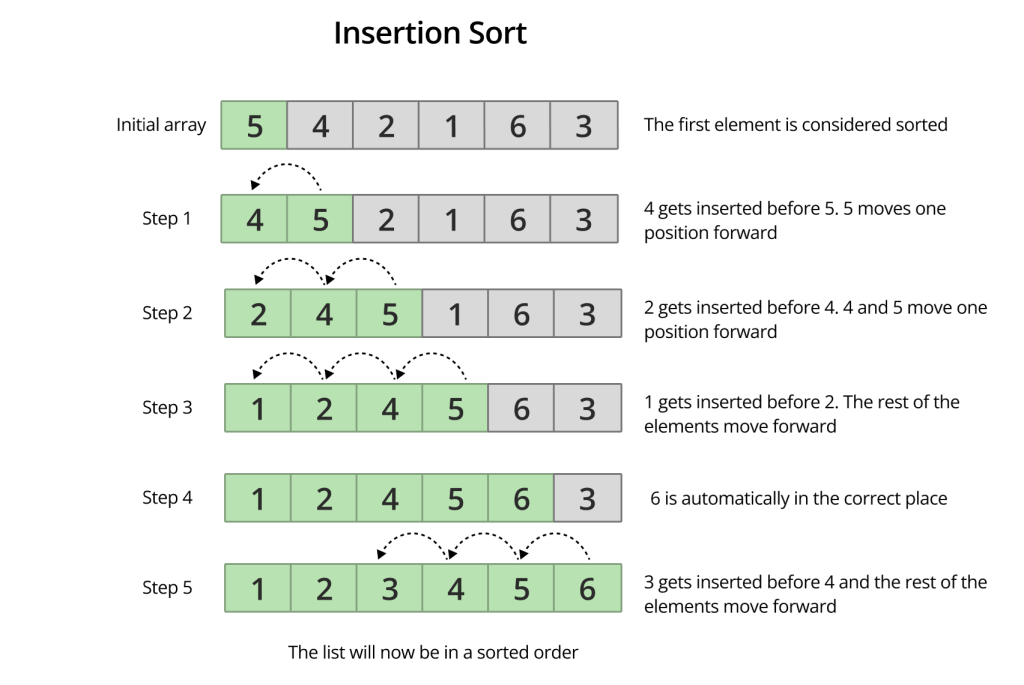
iInsertion Sort is the algorithm you likely use subconsciously every time you organize a hand of playing cards. It splits your data into a “sorted” and “unsorted” section, pulling one item at a time from the unsorted pile and shifting it into the correct spot within the sorted section. It performs very well on partially sorted data and uses hardly any extra memory, making it a highly practical and efficient approach for smaller datasets.
Quick Sort
Quick Sort is a highly efficient, “divide-and-conquer” approach to handling massive amounts of data. It works by picking a “pivot” element and then partitioning the rest of the array so that all numbers smaller than the pivot go to the left, and all larger numbers go to the right. It then recursively applies this same process to the left and right sub-arrays. Because it shaves off large chunks of work in every step, it averages an impressive \(\mathcal{O}(n \log n)\) time complexity.
Heap Sort
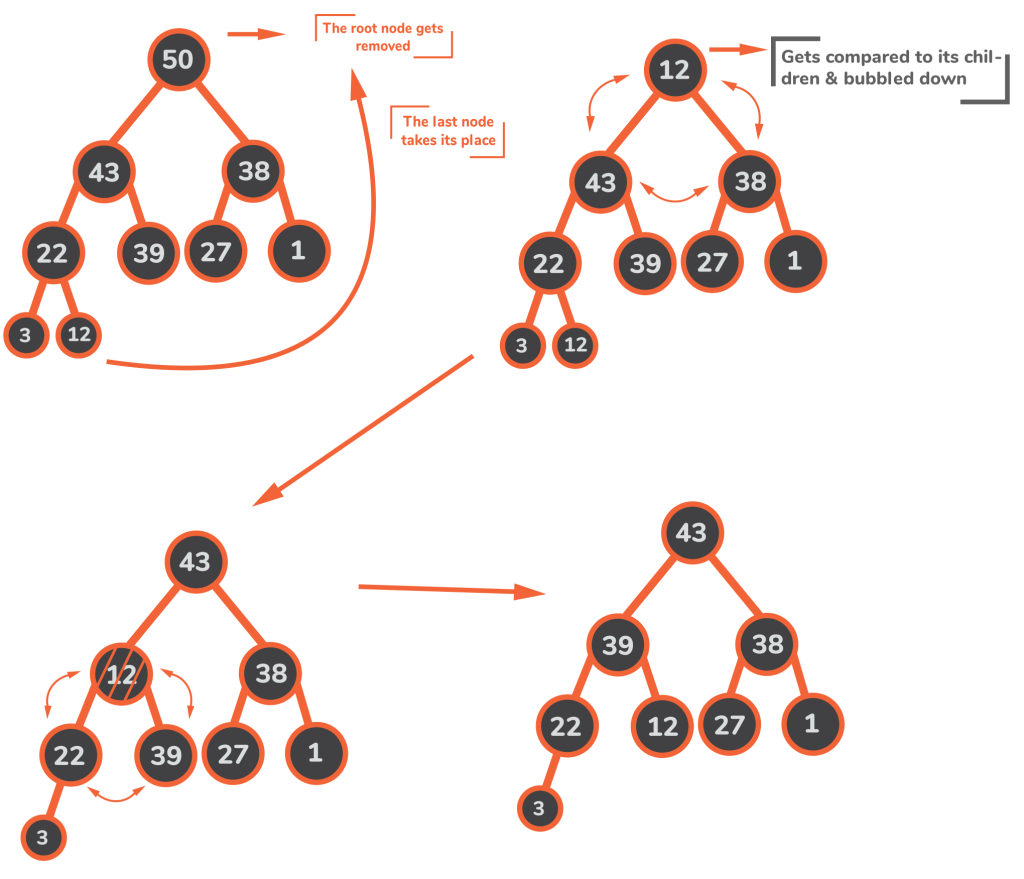
Heap Sort takes a completely different route by first organizing all your data into a tree-based structure called a binary heap. Once the data is structured, the largest (or smallest) item sits right at the top. The algorithm extracts this top item, places it in its final sorted position, and then restructures the tree to find the next item. The result is a highly reliable algorithm with a \(\mathcal{O}(n \log n)\) time complexity, guaranteeing great performance even in the absolute worst-case scenarios.